

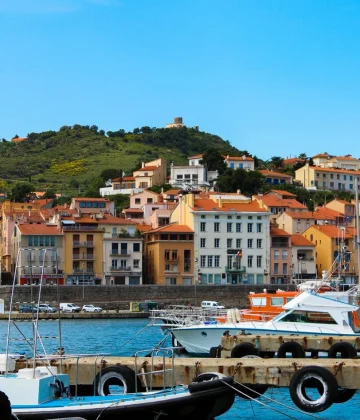




Port-Vendres and its port have a history that spans more than two thousand years! From the ancient Portus Veneris to the city we know today, I will tell you how this Mediterranean harbor has traversed the centuries and shaped the identity of Port-Vendres.
Over the centuries, the harbor of Port-Vendres occupies a strategic position on the Mediterranean coast.
Navigation, trade and defense will each in turn contribute to its development and profoundly transform the city.

Ancient remains, Vauban fortifications, an obelisk, and major 18th-century works still bear witness to this evolution. In the 19th and 20th centuries, the growth of trade and maritime links with Algeria opened a new chapter in its history. Heavily damaged during the Second World War, Port-Vendres subsequently rebuilt itself and diversified its activities.
Today, this maritime, military and commercial past can still be discovered through many elements of the city's heritage.
A port known since antiquity
From antiquity, the harbor of Port-Vendres has attracted sailors. Ancient authors mention it as Portus Veneris, the port of Venus. Pomponius Mela cites it in the 1st century AD as one of the main landmarks of the Mediterranean coast. Strabo, Pliny, and Ptolemy also mention this port located at the foot of the Pyrenees, near the border between Gaul and Spain.

This name is thought to be linked to a temple dedicated to Venus, the Roman goddess and protector of sailors. Located on a promontory overlooking the harbor, it likely served as a landmark for ships. Its precise location remains a subject of debate.
However, fragments of mosaic, pottery and marble discovered in 1881 at the foot of the Fanal have led several historians to place the sanctuary in this area.
Underwater archaeological research confirms the importance of the bay during Antiquity. Several shipwrecks discovered in the port, the channel and around Cap Béar attest to active maritime traffic. The Port-Vendres 2 shipwreck, dated to around 45 AD, notably carried oil, wine, brine, ores and tableware.
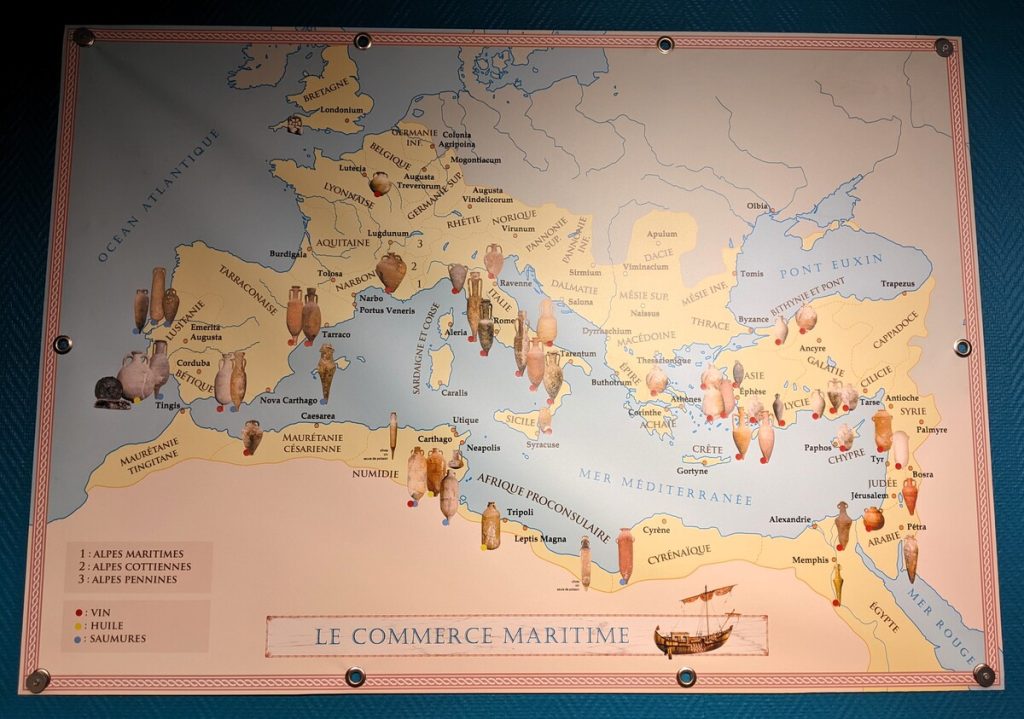
These cargoes show that the bay was located on the trade routes linking Baetica, Gaul, Italy, and other Mediterranean ports. At that time, the harbor served primarily as an anchorage and secondary port, playing a role in the redistribution of goods to the hinterland.
A bay long linked to Collioure
After Antiquity, the bay of Port-Vendres retained its appeal for sailors, but the site did not yet constitute an independent town. The territory remained attached to Collioure. A few huts occupied the shores of the harbor, while the hills served to monitor the coast and shipping lanes.
In the Middle Ages, the port played a role in trade between the Catalan coast, the Balearic Islands, Barcelona, Valencia, and the ports of Languedoc, Provence, and Italy. Ships found shelter and a redistribution point for goods there. However, the bay remained a natural anchorage, and no major medieval port developments are known to date.

In 1272, King James I of Aragon sought to increase the toll collected at Collioure to finance the construction of a port at Port-Vendres. This project already demonstrated the strategic and commercial importance of the harbor. However, it would take several centuries for the site to truly expand.
A city designed around the port
From the 16th century onwards, the heights surrounding the bay became dotted with towers and defensive structures. The Biarra tower, located near the present-day Fort Béar, guarded access to the port. Other fortified positions protected Collioure and its surroundings.
In the 17th century, after the annexation of Roussillon to the Kingdom of France, Port-Vendres became fully integrated into French military strategy. Vauban recognized the defensive and maritime advantages of the bay. He considered the site better suited than Collioure to host the region's main port.
Work began in the early decades of the 18th century, but progressed slowly, with several interruptions. Quays were built and the defenses were strengthened. The Fanal redoubt, the Béar redoubt and the Presqu'île redoubt monitor access to the harbor.


In 1750, the Count of Mailly, Lieutenant General of Roussillon, revived Vauban's plans. He wanted to build a monumental city organized around the port. The complete project was never realized, but several buildings still shape the city's heritage today.
Between 1776 and 1778, the western part of the port was excavated. The town is organized around the Place de l'Obélisque and the Fer à Cheval barracks. In the center of the square stands a polychrome marble obelisk nearly 30 meters high. Its decoration celebrates the monarchy and the rebirth of the port.
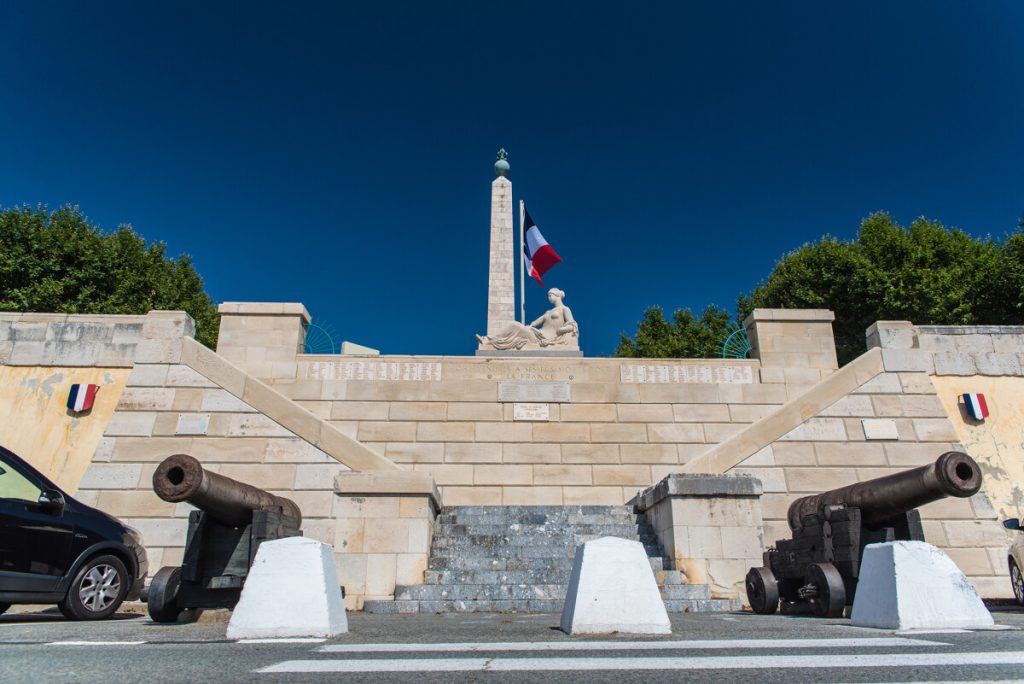
Port-Vendres thus became a city conceived around the sea, defense and royal power. However, the population settled there slowly. In 1782, the census counted barely 88 inhabitants.
A port geared towards trade
At the beginning of the 19th century, this small town remained attached to Collioure. The situation changed in 1823, when it became an independent municipality. This autonomy coincided with new development projects for the harbor.
From 1836 onwards, the Navy financed major works. A jetty, slipways, a quarantine station and shops are built. The new dock is 300 meters long, 145 meters wide and 9 meters deep. The excavated material is being used to develop Place Castellane.

The port infrastructure was completed around 1860. In 1867, the arrival of the railway opened up Port-Vendres and facilitated connections with the Mediterranean network.
The city then sought to compete with Sète and Marseille to develop maritime links with Algeria. In 1880, the port became a stopover for the ocean liners of the Compagnie Transatlantique. The Compagnie de Navigation Mixte succeeded it in 1895.
Trade is expanding. Wine and iron ore are among the exports from the port. In return, it receives grain, carob, Norwegian timber, and coal.
This activity gradually transformed the town. Its population grew from 1,671 inhabitants in 1856 to 3003 inhabitants in 1886. Construction of the Notre-Dame de Bonne Nouvelle church began that same year.
The growth of links with Algeria
At the beginning of the 20th century, Port-Vendres continued its development thanks to maritime links with Algeria. After the First World War, passenger traffic grew rapidly. In 1922, the Compagnie de Navigation Mixte received several passenger ships assigned to routes between France and North Africa.
The new maritime station was inaugurated in 1929. It replaced an old wooden hangar and coincided with the opening of the Grand Hotel of the Compagnie du Midi. The ocean liners then connected Port-Vendres to Algiers and Oran. Traffic reached 60 passengers in the mid-1920s, then 000 in 1930, the centenary year of the conquest of Algeria.


The commercial port also saw significant activity. In 1935, imports reached 84,886 tons. These consisted mainly of wines, fruits and early produce from Algeria, as well as cork. Exports amounted to 16,198 tons.
The iron ore from Canigó, once important for the port's activity, is gradually declining. Port-Vendres thus combines several functions: passenger port, commercial port and military port.

In the turmoil of war
From 1936 onwards, the Spanish Civil War led to the arrival of refugees in the region. On September 7, 134 people from Barcelona disembarked in the port aboard the torpedo boat Cort II. In 1939, hospital ships also received wounded Spaniards following the tragic episode of the Retirada.
World War II profoundly disrupted the life of the city. Its strategic location attracted the attention of French, then German, forces. After the German occupation in November 1942, the area became a heavily controlled military stronghold. The quays, fortifications, and several sectors of the town were closed to residents. The Germans took control of the French coastal batteries and built new concrete fortifications at Cap Gros and Cap Béar.


Beginning in June 1944, the port was progressively mined. Pits dug in the quays housed powerful explosive charges. On August 19, as they were leaving, German troops sank two ships in the port before blowing up the quays and several installations. The explosions destroyed part of the infrastructure and damaged numerous houses. When Port-Vendres was liberated on August 20, 1944, the town was heavily damaged.
Post-war, a port turned towards new activities
After the destruction of 1944, Port-Vendres began a long period of reconstruction. The quays, port buildings, and damaged houses were gradually restored. The town, however, still bears the marks of its military past, visible in its forts, batteries, and various defensive structures.
The port gradually resumed its activity. Links with Algeria continued until the upheavals linked to Algerian independence in 1962. The arrival of numerous repatriates then transformed the population and local life.

Trade remains an important activity. The port receives goods, as well as fruit, mainly bananas, by sea. Fishing also plays a central role in the economy and identity of the town.
The quays became bustling workspaces, filled with unloading, sales, and exchanges between sailors and locals. Over the decades, the port diversified its activities. Fishing boats mingled with merchant ships, pleasure craft, and excursion boats.
A story to discover as you explore the city
Even today, the history of the port can be read in the landscape of Port-Vendres. From the quays to the fortifications, from the obelisk to the traces left by different eras, one only needs to walk around the town to find the evidence.
So, during your next stroll in Port-Vendres, keep your eyes peeled: behind the landscapes of the harbor lie more than two thousand years of history!
Themes